
1
Early Bug Detection & Parallel Development
Shorten development cycles and allow multiple developers to work simultaneously.




Modern automotive ECU software is increasingly complex, and testing after hardware completion often leads to delays and high costs. GSIL solves these challenges by enabling early-stage verification — without hardware.
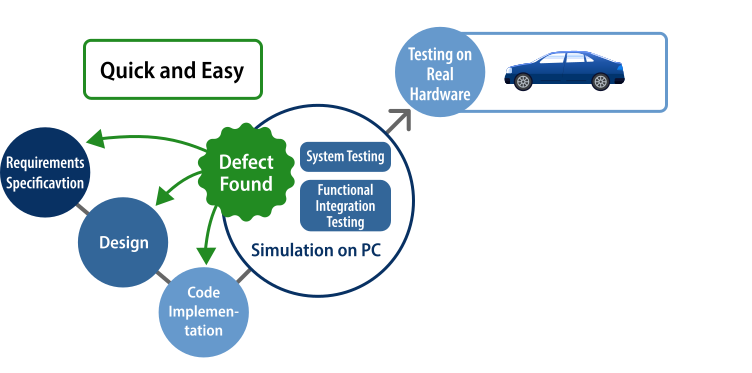
Software-in-the-Loop Simulation (SILS) allows developers to test ECU application source code — whether handwritten or auto-generated from Simulink — on a PC before hardware is ready.
Benefits include:

Shorten development cycles and allow multiple developers to work simultaneously.

Automated exhaustive testing ensures reliability without extra tools.

Integrate static analysis, virtual ECU generation, testing, and coverage measurement.

Minimal manual code changes, automatic stub generation, and link error resolution.

DLL-based virtual environments ensure secure sharing between OEMs and suppliers.
GTrainer offers a software-only learning package — no hardware required.
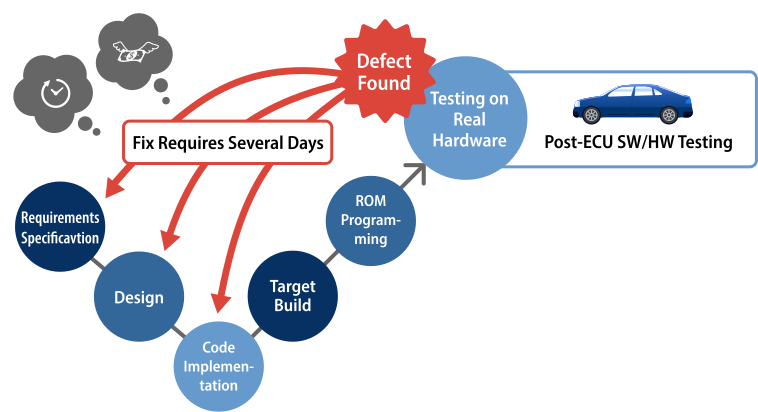
In automotive ECU software development, the V-model is commonly used. The later a defect is discovered in the process, the more steps need to be redone, resulting in significant rework costs.
The graph illustrates the cost of fixing a single defect at different development phases. Before implementation, the cost is relatively low, but it skyrockets after testing begins.
In particular, if a defect occurs after mass production and leads to a recall, it causes enormous costs and damages brand reputation. Therefore, detecting and fixing defects as early as possible is essential. This concept is known as front-loading or shift-left.
SILS enables verification of ECU application source code--automatically generated from MILS models--on a PC, and supports CI-based automated testing. By allowing easy, automated code verification before hardware completion, SILS makes software development and testing more efficient, reduces workload, and helps control rework costs.
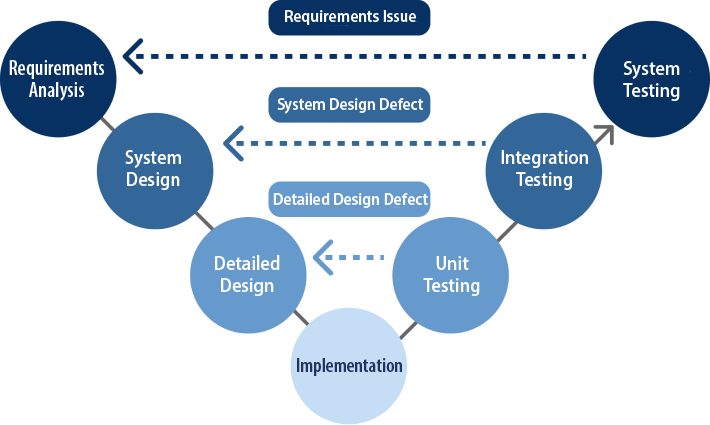
Rework man-hours for bug fixes in the V-model
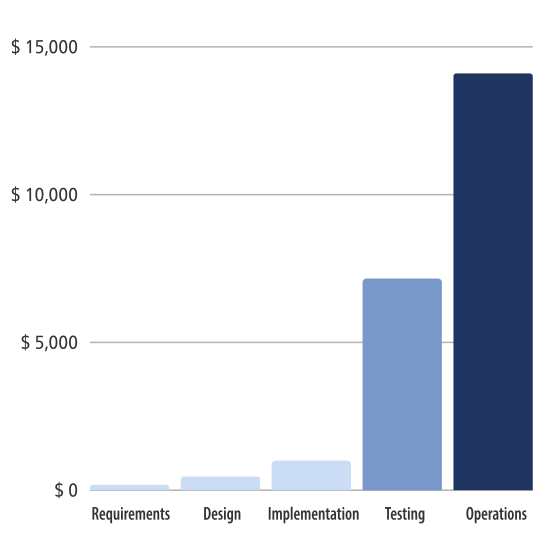
Correction cost per defect at each stage of development

(Currently available in Japanese only)
Learn more about GSIL's features and use cases through our on-demand webinars. To watch the videos, please register using the link below.
Watch GSIL Demo Videos(Currently available in Japanese only)
*HILS (Hardware-in-the-loop simulation) : A simulation method that uses an actual control device (ECU) together with a simulated controlled system.

Annual maintenance includes technical support, vECU build services, CI assistance, and training.
Shift-left your testing, reduce risks, and deliver faster.
Explore our technical insights to see how GSIL transforms ECU software engineering.
The importance of ECU control software keeps growing, and the test effort that comes with it has become enormous. How can teams make the best use of their test assets? Here we introduce techniques for using those assets effectively, along with the tools that support them.
In recent years, more automotive control-software teams have adopted Software-in-the-Loop Simulation (SILS) to make development more efficient. SILS allows code to be verified easily on a PC before hardware is complete, enabling more efficient software development and verification, along with reduced effort.
In ECU control software development, defects found later in the V-model require more rework. Learn why early defect detection is critical for reducing costs.
Learn how Continuous Integration (CI) improves development efficiency by automating code integration and testing, detecting defects early, and reducing rework.
If MILS enables model-based development, automatic code generation, and ECU validation, what additional benefits can a SILS tool like GSIL provide?
SILS enables ECU software verification on a PC before hardware is available, supporting CI, automated testing, reduced rework, and improved reliability. GSIL adds CAN support for broader application.
Improve embedded control software development efficiency with GSIL simulation on PC. Reduce rework, enable automated testing and CI/CD, and boost reliability before hardware is ready.
Coverage measurement helps track testing progress, but 100% coverage does not guarantee all input combinations have been tested or that defects are absent.
Continuous Integration (CI) automates static analysis, unit testing, and integration testing after each code commit, improving quality and development efficiency.
Improve ECU reliability with GSIL’s comprehensive automated test case generation. Detect hard-to-find runtime errors like division by zero and buffer overruns through exhaustive simulation testing.
Struggling to improve coverage or find bugs caused by unexpected input combinations? Learn how GSIL's automated exhaustive testing supports Shift-Left development and improves test effectiveness.

Explore GSIL's features and use cases through our on-demand videos.