Linux/Android Fast Boot SolutionUbiquitous QuickBoot
Don't wait. QuickBoot.

Don't wait. QuickBoot.
Ubiquitous' QuickBoot can boot any device in seconds - no more waiting. QuickBoot utilizes advanced hibernation technology to nearly instantaneously bring your device back to life from a complete power down state. QuickBoot analyzes system memory and determines the most efficient way to restore the system to a fully booted state.
QuickBoot is a cold boot technology. Devices do not need to maintain standby power or drain their battery when using QuickBoot.

Demo Videos
QuickBoot Demo
(Android 13 on Telechips TCC8050EVB)
QuickBoot Demo
(Linux on NXP i.MX 8M EVK)
QuickBoot Demo
(Android 10 on MediaTek MT2712 EVB)
QuickBoot Demo
(Linux on STM32MP1 EV1)
Case studies Video
(KENWOOD MDV-Z700)
Features
QuickBoot is a cold boot technology. Devices do not need to maintain standby power or drain their battery when using QuickBoot.
With QuickBoot, manufacturers can develop digital home electronics, automotive (IVI) and mobile devices that can be instantly launched from zero standby power without compromising user operability. Ubiquitous works with world leading companies to create cutting edge devices.
Available for Linux and Android Operating Systems, QuickBoot is delivered as an SDK for easy integration and customization.
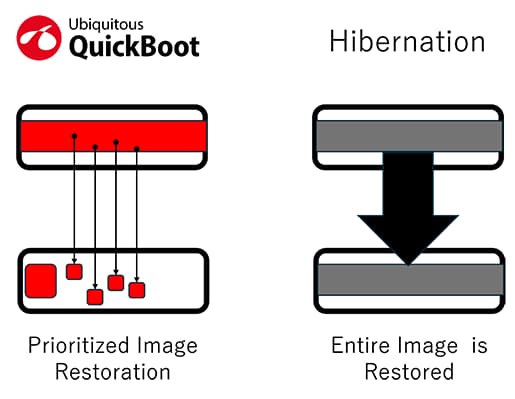
Key Functions
- Secure Boot Compatibility
Boot Fast and Secure. Existing Secure Boot processes can be used to verify QuickBoot, while verification of the Snapshot Image can be handled within QuickBoot to provide robust security alongside dramatically shortened boot times. - Increased Performance
Advanced loading algorithms can reduce the QuickBoot time by up to 40% compared to previous versions. Similar advancements have also been made to cut the Snapshot Creation time by up to 50%. - OptimizationOptimization tools provided with the QuickBoot SDK allow Customization of the Snapshot Image. Boot Time and QuickBoot behavior can be tuned to give a seamless User Experience.
- Multi-Core Support
Customize QuickBoot by implementing threads which can run concurrently with QuickBoot. Update the display, play audio, show the Rear-View camera or check the status of the CAN bus all while QuickBooting. - Open Source
Easily customize the QuickBoot SDK for your Target Platform. All hardware dependent functions are open source allowing for easy porting. - Android
Application installation, Settings Restoration, OTA, Factory Reset are all supported with the Android Pack add on. Available for Android. - Storage Media
The latest eMMC and SD standards are supported. The High Speed Modes (HS200/HS400/UHS-I) can deliver incredibly short Boot Times and the Instant-On experience to customers.
Package Structure
QuickBoot SDK
QuickBoot is delivered as a Software Development Kit (SDK) configured for your target environment. The SDK includes the necessary patches for your Kernel and Bootloader along with Manuals, Examples and Guides making it simple to integrate QuickBoot into your project.
Android Pack
The Android Pack is an optional add-on package required for products that use the Android operating system.
Compatibility
| Hardware Requirements | CPU | ARM Architecture | ARM v7 and v8 (aarch32 and aarch64) |
|---|---|---|---|
| x86-64 Architecture | Intel Atom | ||
| Software Requirements | OS | Linux | Kernel 3.x and above |
| Android | Android 7.x and above |
Adoption Examples


e-book readers



Images are for illustration purposes and may differ from actual products.
On-Demand Webinar
In this recorded session, we present an in-depth overview of QuickBoot, the cutting-edge solution designed to dramatically shorten the boot time of Linux/Android-based systems. By watching this video, you'll gain a comprehensive understanding of QuickBoot's functionalities and how it revolutionizes system boot times. Join us to uncover the secrets behind faster and more efficient system startups.
- Video playback time is 15 and a half minutes.
- The session was recorded in January 2021.