Applying GSIL to MILS Development

With Model-in-the-Loop Simulation (MILS) tools such as Simulink, you build a control model by wiring together the modeling libraries the tool provides — addition/subtraction blocks, PID control, and so on — letting you verify a control-ECU controller or vehicle plant model on a PC. Once that model is used to auto-generate code targeted at the real ECU's microcontroller, on-target verification is possible — without hand-written-code debugging work (setting the BSW portion aside) — even without a SILS tool like GSIL. So if you're already developing this way, is there still a benefit to using an SILS tool like GSIL?
1. The Benefits of GSIL in MILS Development
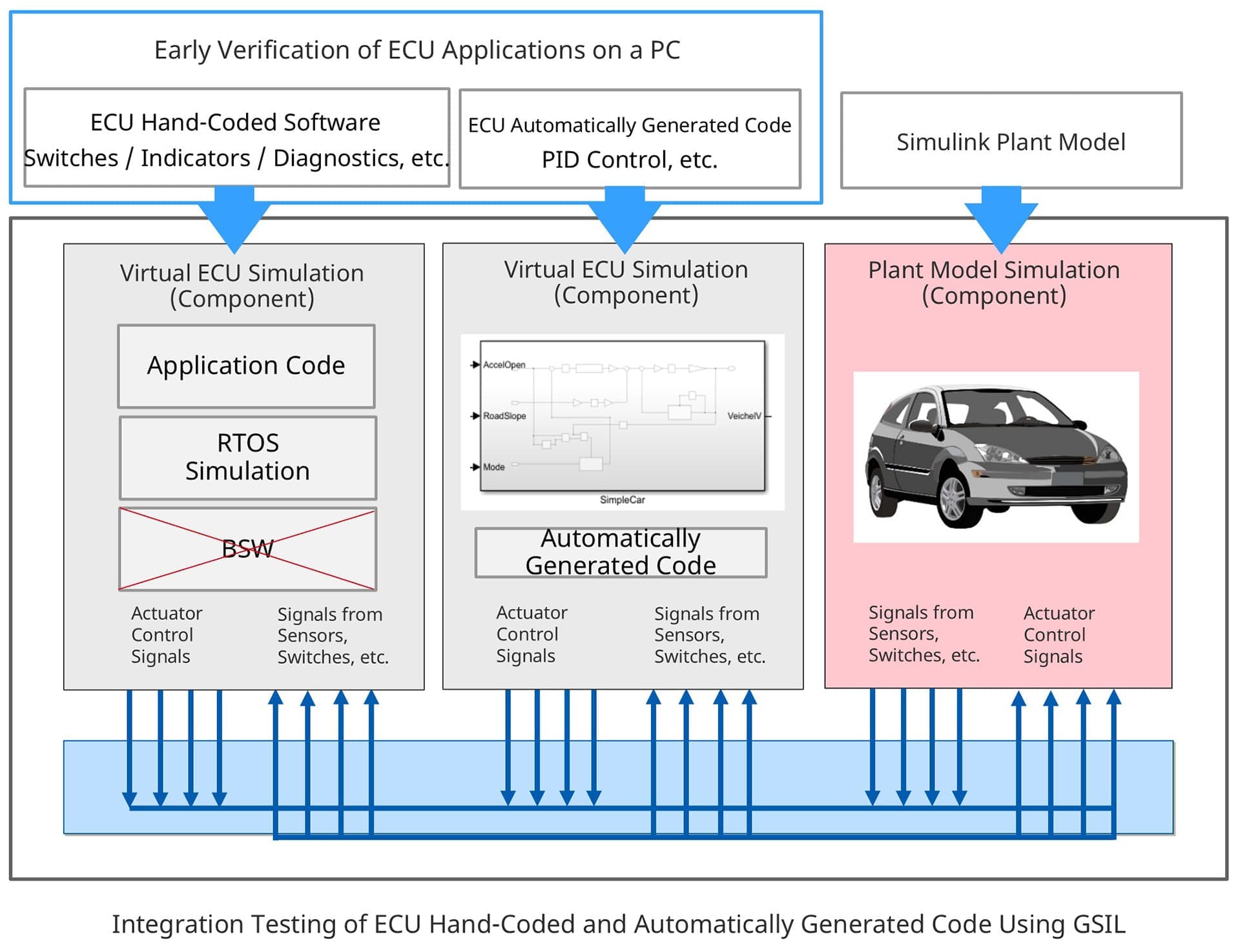
1-1. Integration Testing of Auto-Generated and Hand-Written Code
One benefit is being able to run integration tests combining auto-generated code with hand-written code. In model-based development, it's efficient to build control-related portions such as PID control using models, while developing everything else with hand-written code. Engineers already working in C also need to learn a new modeling approach, and when extending legacy C code it's often more efficient to keep using C directly. In such cases, code auto-generated from a model needs to be tested together with the remaining hand-written C code — something GSIL makes straightforward.
1-2. Automated Exhaustive Testing
To improve reliability, GSIL can automatically generate, execute, and verify an enormous number of test cases that would be impossible to create by hand. MILS tools sometimes offer similar functionality, but it's typically an add-on feature that carries meaningful extra cost. Those tools also tend to focus on raising the coverage percentage, which by itself doesn't equate to testing a large number of combinations. GSIL, by contrast, performs automated exhaustive testing at no additional cost. Simply varying inputs at random produces tests very different from real vehicle driving and isn't meaningful — GSIL lets you attach constraints to input values, making tests closer to what would actually happen in a real vehicle.
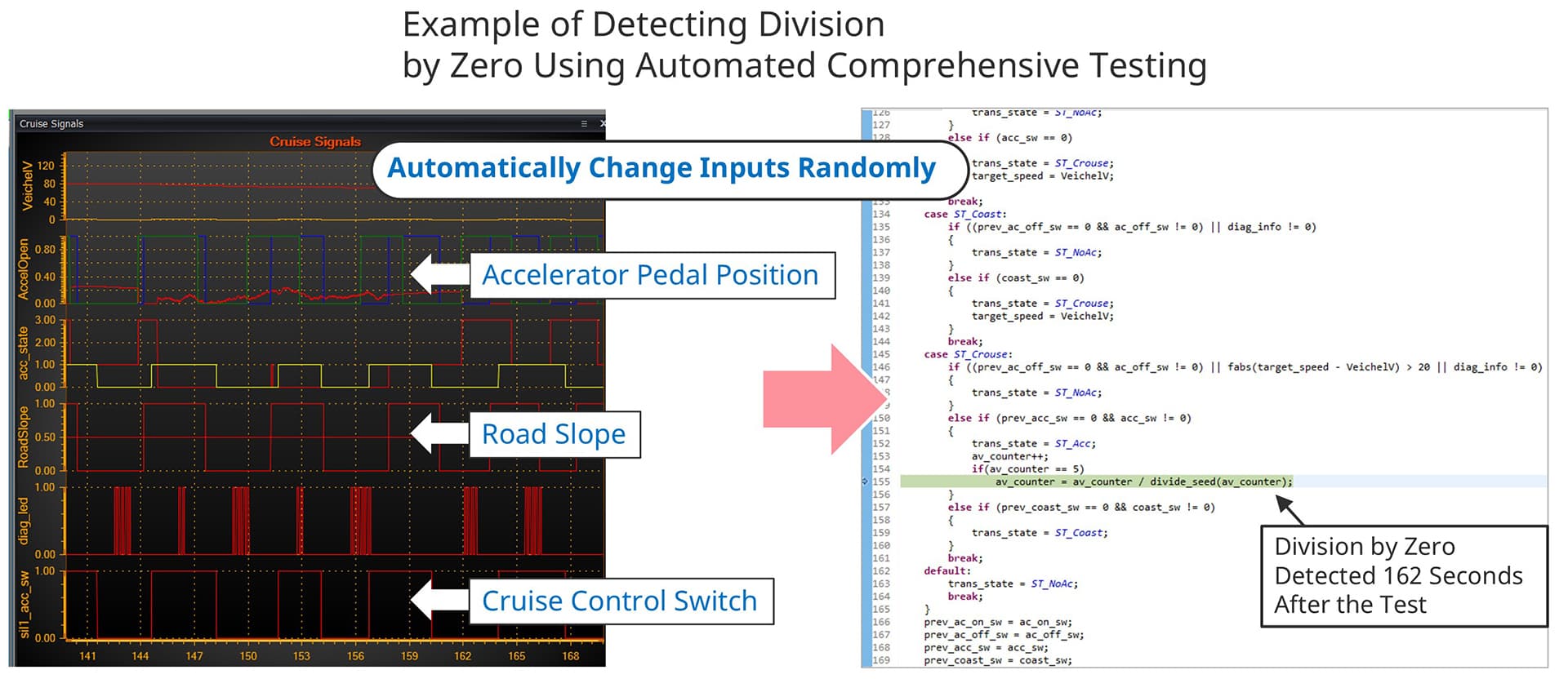
Example of automated exhaustive testing
1-3. Back-to-Back (B2B) Testing
In model-based development, Back-to-Back (B2B) testing — confirming that a model and real hardware behave the same way — is necessary. GSIL makes B2B testing easy. First, run the automated exhaustive testing described above in GSIL and export the resulting test cases to CSV, which contains an enormous number of variable combinations. That CSV (the input CSV) is then run through the model-based environment, with its output written to another CSV.
The same input CSV is then run against real hardware once it's complete, and its output is likewise written to CSV. Comparing the two output results confirms whether the model and real hardware behave identically.
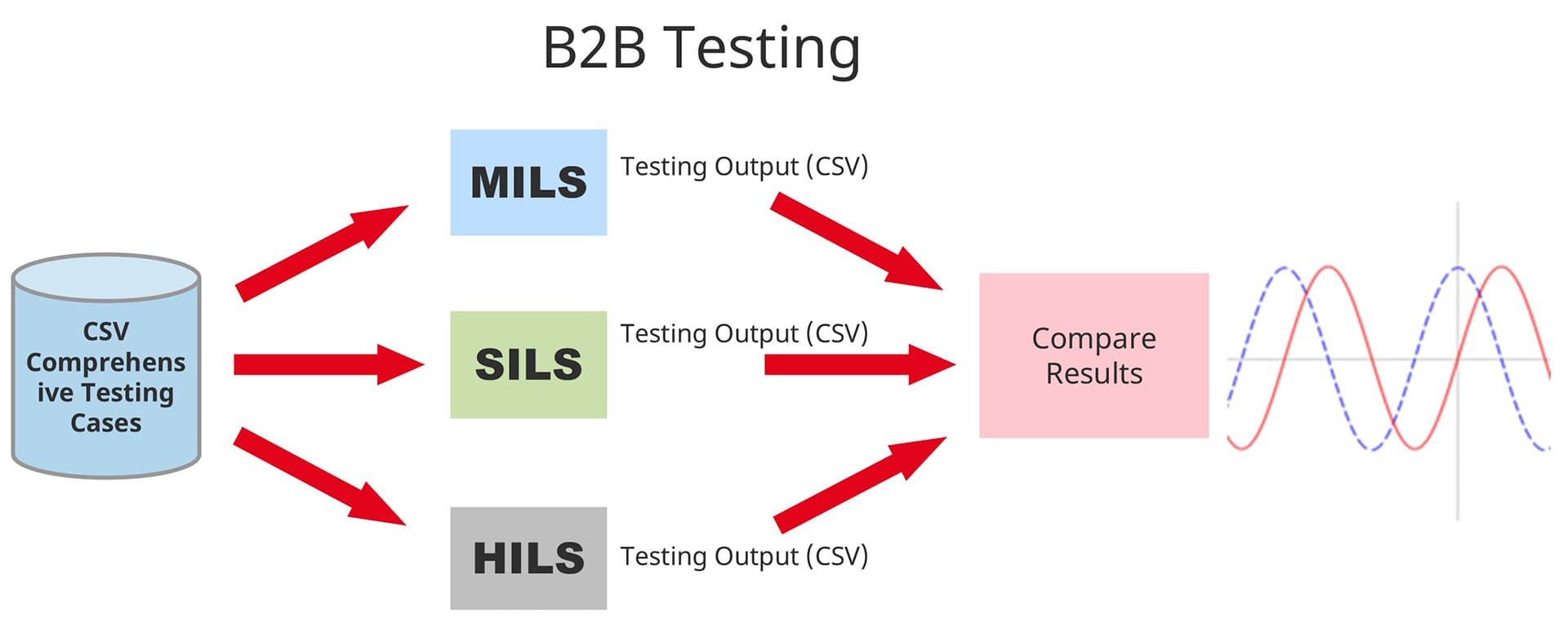
Back-to-Back testing
1-4. Timing Verification
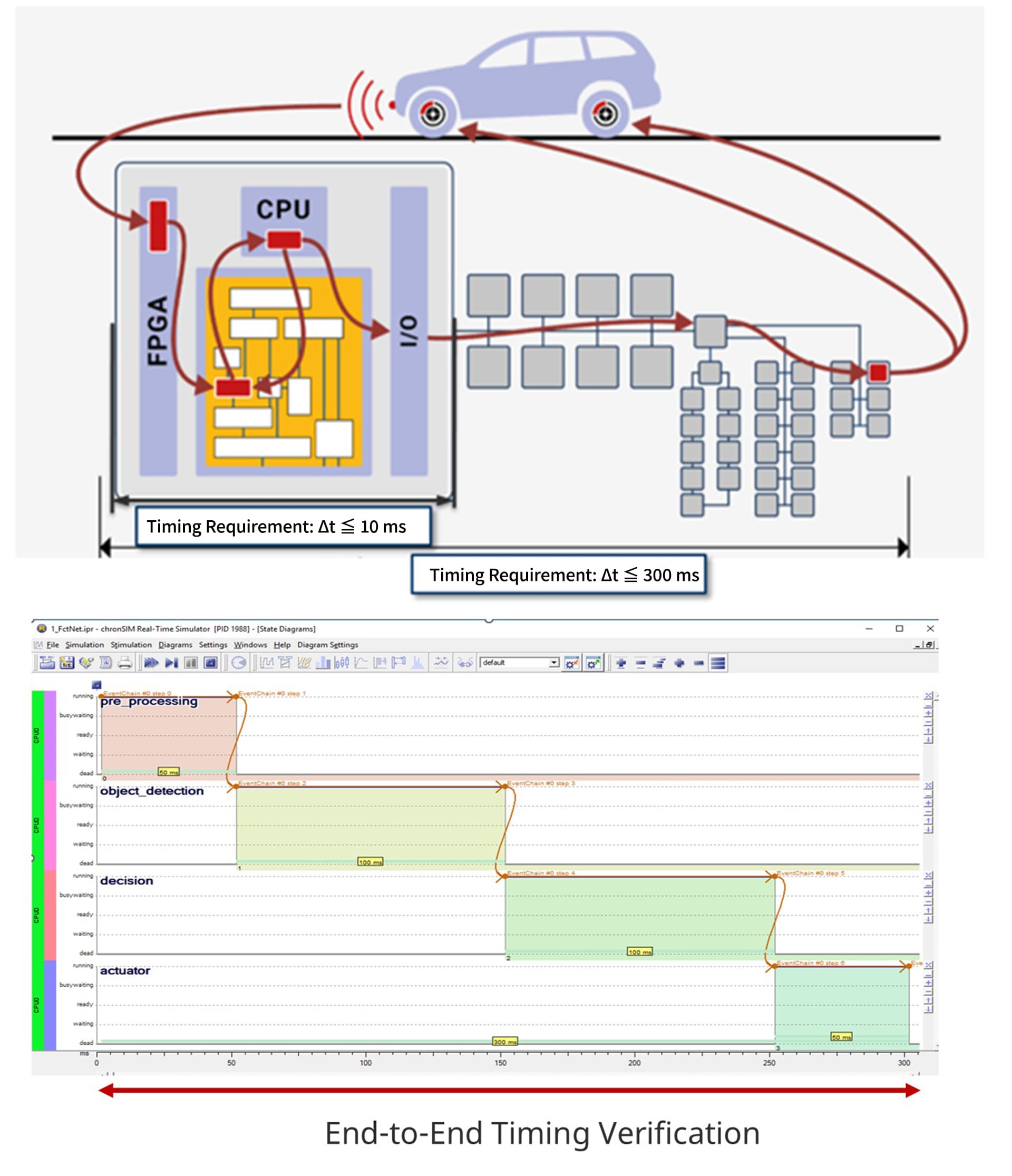
Automotive ECU control has timing requirements — such as "complete processing within a specific time" — and timing verification confirms whether those requirements are being met. However, because MILS and real hardware execution environments differ so significantly, timing verification within MILS alone is difficult. GSIL, by contrast, enables timing verification by using our companion tool chronVIEW.
2. Summary
As shown here, applying GSIL to model-based development brings a range of benefits. If you're interested, we'd encourage you to take a look at the product page, where GSIL is explained in more detail.
Author

Ubiquitous AI Corporation
Embedded Business Unit 3, Deputy General Manager
Hiroshi Ueda
After university, Ueda joined a Tier 1 supplier and worked on ECU software development. He later worked overseas as an embedded software development engineer before returning to Japan, where he has been engaged in technical sales for automotive software since 1998. Drawing on his own experience, he sources overseas software products that help solve customers' development challenges and delivers them to engineers in Japan.
Related Insights
-
Making the Most of Test Assets in Automotive ECU Simulation
The importance of ECU control software keeps growing, and the test effort that comes with it has become enormous. How can teams make the best use of their test assets? Here we introduce techniques for using those assets effectively, along with the tools that support them.
-
Strengthening Competitiveness in Automotive Control ECU Software Development with SILS
In recent years, more automotive control-software teams have adopted Software-in-the-Loop Simulation (SILS) to make development more efficient. SILS allows code to be verified easily on a PC before hardware is complete, enabling more efficient software development and verification, along with reduced effort.
-
Reducing Rework Between OEMs and Suppliers by Sharing an ECU Control Software Environment
In ECU control software development, defects found later in the V-model require more rework. Learn why early defect detection is critical for reducing costs.
-
Applying GSIL to Continuous Integration (CI)
Learn how Continuous Integration (CI) improves development efficiency by automating code integration and testing, detecting defects early, and reducing rework.
-
SILS Testing Using CAN — Vehicle-Wide Simulation and Test Case Reuse
SILS enables ECU software verification on a PC before hardware is available, supporting CI, automated testing, reduced rework, and improved reliability. GSIL adds CAN support for broader application.
-
Improving Development Efficiency in Embedded Control Software Through Simulation
Improve embedded control software development efficiency with GSIL simulation on PC. Reduce rework, enable automated testing and CI/CD, and boost reliability before hardware is ready.
-
Measuring System-Level Test Coverage
Coverage measurement helps track testing progress, but 100% coverage does not guarantee all input combinations have been tested or that defects are absent.
-
Challenges and Solutions for CI in Embedded Control Software
Continuous Integration (CI) automates static analysis, unit testing, and integration testing after each code commit, improving quality and development efficiency.
-
Improving ECU Reliability with GSIL's Comprehensive Automated Test Case Generation
Improve ECU reliability with GSIL’s comprehensive automated test case generation. Detect hard-to-find runtime errors like division by zero and buffer overruns through exhaustive simulation testing.
-
Achieving 90%+ ECU Software Coverage — GSIL's Automated Exhaustive Testing
Struggling to improve coverage or find bugs caused by unexpected input combinations? Learn how GSIL's automated exhaustive testing supports Shift-Left development and improves test effectiveness.