Measuring System-Level Test Coverage

Coverage measurement is used as one way to track testing progress and as a completion criterion. C0 (statement) coverage, for example, is the proportion of source-code lines that were executed during testing, out of the total lines measured. However, reaching 100% coverage doesn't mean every combination of inputs has been tested, and it doesn't prove the absence of defects.
1. Why System-Wide Coverage Measurement Is Hard in Embedded Systems
In embedded software, coverage measurement is typically done at the level of individual unit functions (unit testing), but system-wide measurement is rarely performed. The reason is that coverage measurement relies on a technique called instrumentation, which embeds measurement macros into the source code and requires memory to record measurement data — and real embedded hardware, with limited ROM/RAM, makes system-wide coverage measurement difficult.
That said, compared with unit-test-level coverage measurement, system-wide coverage measurement offers real advantages:
- No need to implement drivers or stubs, making test setup simpler
- Enables more combination testing with less effort than unit testing
- Because multiple functions call each other as real functions rather than stubs, testing more closely resembles actual runtime behavior
2. Using a Coverage Tool Suited to Embedded Systems
Testwell CTC++, from Germany's Verifysoft Technology and sold in Japan by Ubiquitous AI, is a coverage-measurement tool capable of measuring system-wide coverage even in environments with limited ROM/RAM. Using Testwell CTC++, system-wide coverage measurement becomes achievable even in embedded systems with tight memory constraints.
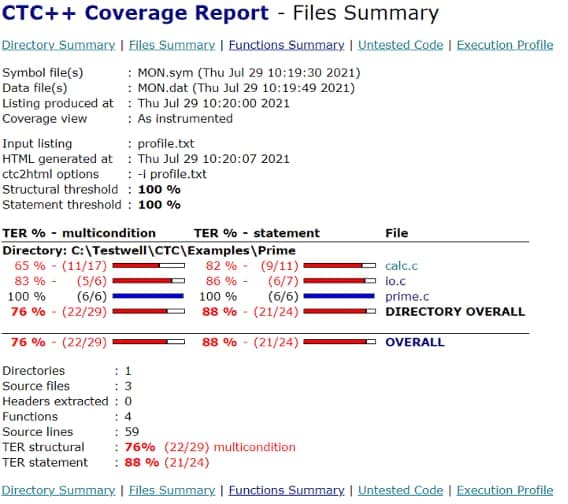
Coverage Measurement Report (Coverage Rate)
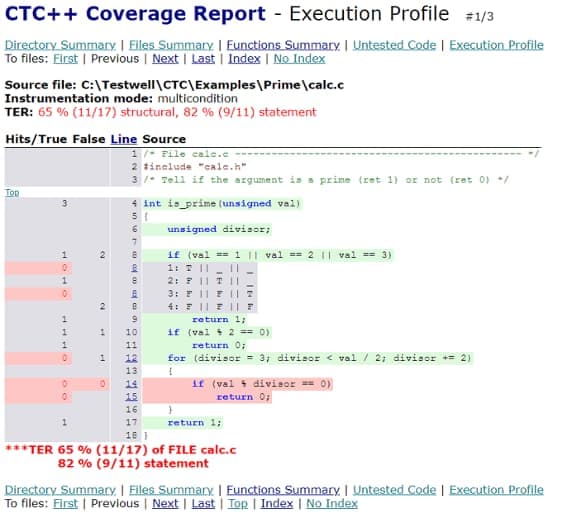
Coverage Measurement Report (Uncovered Code)
3. Automatically Detecting Runtime Errors with Automated Exhaustive Testing
GSIL, sold by Ubiquitous AI, includes an automated exhaustive testing capability. By testing an enormous number of input combinations that would be impossible to create by hand, it automatically catches hard-to-find runtime errors such as division by zero and buffer overruns, improving system reliability. Applying this capability alongside Testwell CTC++ makes it possible to reach high coverage without ever having to write test cases by hand.
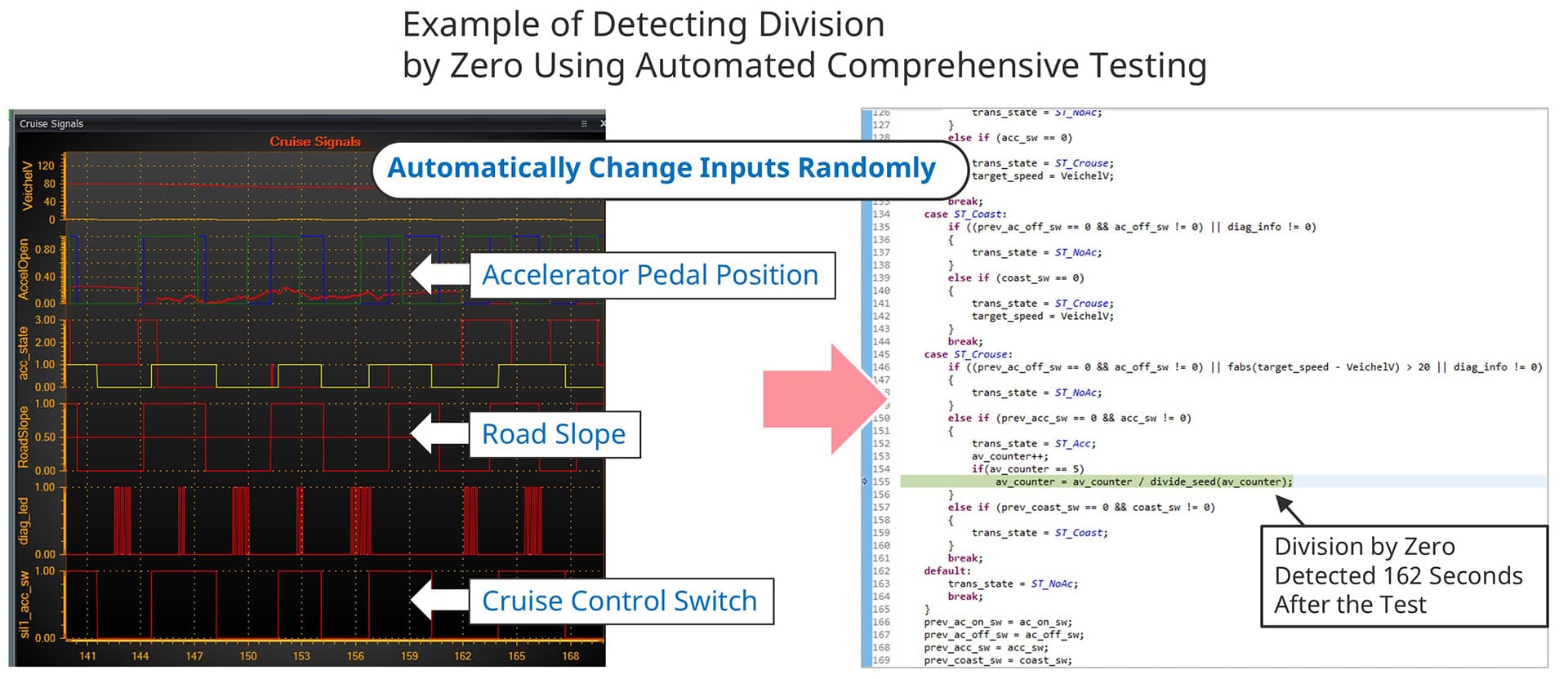
Automated Comprehensive Testing
Testwell CTC++ supports instrumentation, test execution, and coverage-data processing from the console, making CI/CD straightforward to implement.
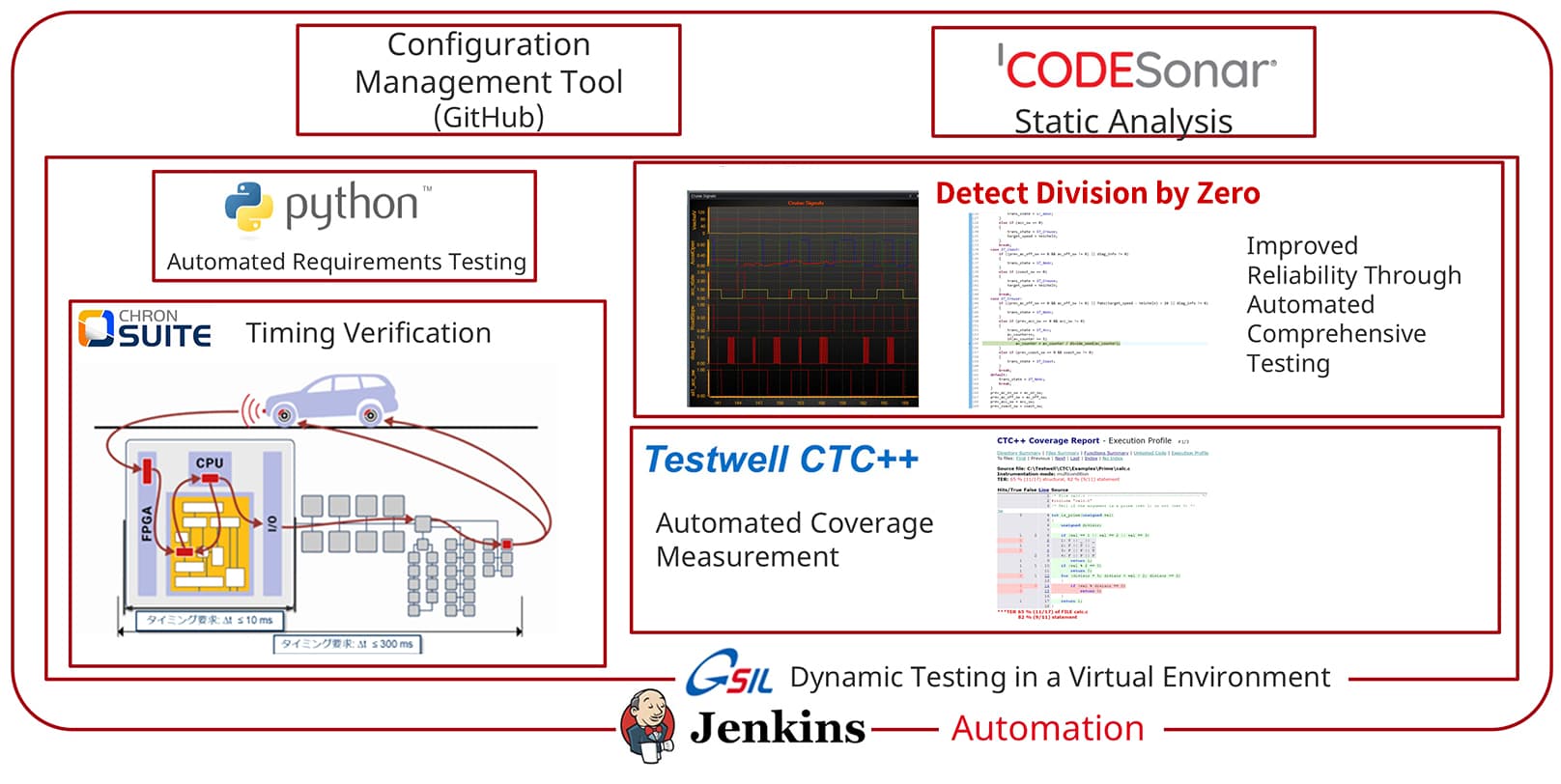
CI/CD Implementation Example
4. Summary
As described here, using Testwell CTC++ for coverage measurement in embedded control software systems reduces test-preparation effort, improves reliability, and makes CI/CD easy to implement. If you're interested, please get in touch using the button below — we'd be happy to explain Testwell CTC++ in more detail.
Author

Ubiquitous AI Corporation
Embedded Business Unit 3, Deputy General Manager
Hiroshi Ueda
After university, Ueda joined a Tier 1 supplier and worked on ECU software development. He later worked overseas as an embedded software development engineer before returning to Japan, where he has been engaged in technical sales for automotive software since 1998. Drawing on his own experience, he sources overseas software products that help solve customers' development challenges and delivers them to engineers in Japan.
Related Insights
-
Making the Most of Test Assets in Automotive ECU Simulation
The importance of ECU control software keeps growing, and the test effort that comes with it has become enormous. How can teams make the best use of their test assets? Here we introduce techniques for using those assets effectively, along with the tools that support them.
-
Strengthening Competitiveness in Automotive Control ECU Software Development with SILS
In recent years, more automotive control-software teams have adopted Software-in-the-Loop Simulation (SILS) to make development more efficient. SILS allows code to be verified easily on a PC before hardware is complete, enabling more efficient software development and verification, along with reduced effort.
-
Reducing Rework Between OEMs and Suppliers by Sharing an ECU Control Software Environment
In ECU control software development, defects found later in the V-model require more rework. Learn why early defect detection is critical for reducing costs.
-
Applying GSIL to Continuous Integration (CI)
Learn how Continuous Integration (CI) improves development efficiency by automating code integration and testing, detecting defects early, and reducing rework.
-
Applying GSIL to MILS Development
If MILS enables model-based development, automatic code generation, and ECU validation, what additional benefits can a SILS tool like GSIL provide?
-
SILS Testing Using CAN — Vehicle-Wide Simulation and Test Case Reuse
SILS enables ECU software verification on a PC before hardware is available, supporting CI, automated testing, reduced rework, and improved reliability. GSIL adds CAN support for broader application.
-
Improving Development Efficiency in Embedded Control Software Through Simulation
Improve embedded control software development efficiency with GSIL simulation on PC. Reduce rework, enable automated testing and CI/CD, and boost reliability before hardware is ready.
-
Challenges and Solutions for CI in Embedded Control Software
Continuous Integration (CI) automates static analysis, unit testing, and integration testing after each code commit, improving quality and development efficiency.
-
Improving ECU Reliability with GSIL's Comprehensive Automated Test Case Generation
Improve ECU reliability with GSIL’s comprehensive automated test case generation. Detect hard-to-find runtime errors like division by zero and buffer overruns through exhaustive simulation testing.
-
Achieving 90%+ ECU Software Coverage — GSIL's Automated Exhaustive Testing
Struggling to improve coverage or find bugs caused by unexpected input combinations? Learn how GSIL's automated exhaustive testing supports Shift-Left development and improves test effectiveness.