Strengthening Competitiveness in Automotive Control ECU Software Development with SILS

In recent years, more automotive control-software teams have adopted Software-in-the-Loop Simulation (SILS) to make development more efficient. SILS allows code to be verified easily on a PC before hardware is complete, enabling more efficient software development and verification, along with reduced effort.
1. What Is SILS?
In recent years, more teams have adopted Software-in-the-Loop Simulation (SILS) to make automotive control-software development more efficient. SILS verifies, on a PC, ECU application source code — whether hand-written or auto-generated from a Model-in-the-Loop Simulation (MILS) tool such as Simulink. Because code can be easily verified before hardware is complete, and supports automated CI-style testing, it enables more efficient software development and verification while reducing overall effort.
2. Challenges of Testing with HILS or a Real Vehicle
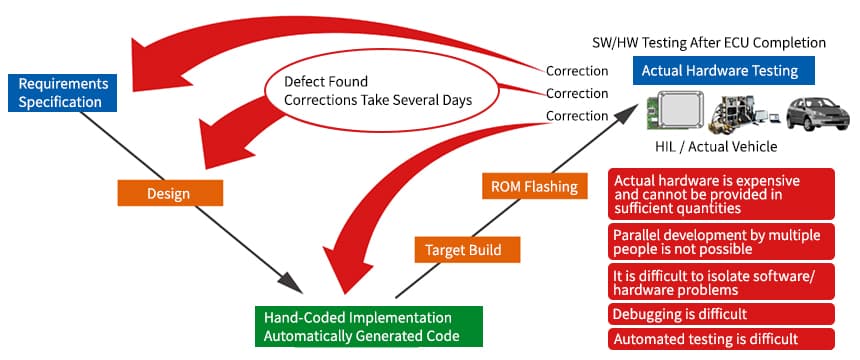
Testing with HILS or a real vehicle comes with challenges such as:
- HILS is expensive, and access is on a first-come, first-served basis — you can't debug while the implementation is still fresh in your mind
- Parallel development across multiple engineers isn't possible
- Separating software problems from hardware problems is difficult
- Debugging is difficult
- Automated testing via CI is difficult
As a result, the time from discovering a defect to fixing it can stretch to several days or more, creating substantial rework effort.
3. How SILS Solves These Challenges
3-1. Strengths of SILS
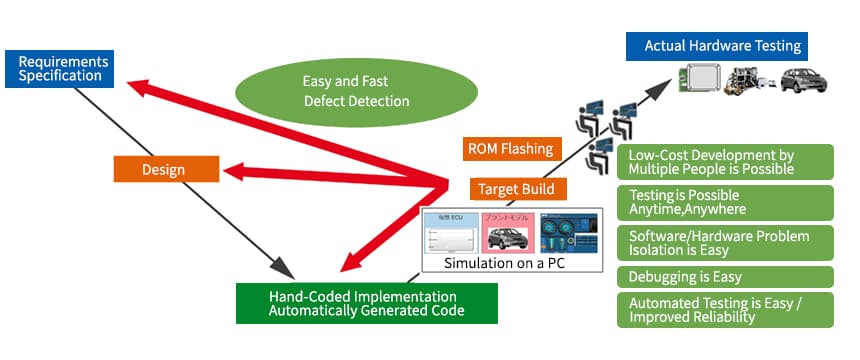
- Testing is possible anytime, anywhere, immediately after implementation
- Low cost, enabling parallel development across multiple engineers
- Easy to separate software and hardware problems
- Easy debugging
- Easy automated testing via CI / improved reliability
Using SILS resolves the challenges of HILS- and real-vehicle-based testing, substantially reduces rework effort, and improves reliability through automated testing.
4. Environment Setup (Building a vECU)
SILS isn't something you can use immediately after purchasing a tool — building a virtual ECU (vECU) comes first. Building a vECU means compiling and running the application-layer source code with a PC-targeted compiler. Because ECU source code uses pragma directives and similar constructs written for the embedded compiler, it can't be used as-is. Compiling only the application layer also produces link errors, since driver-call functions are missing. Traditional SILS requires modifying source code or creating stubs to work around this.
5. Building the Environment with GSIL (vECU Construction)
GSIL — a SILS tool for automotive ECU software development, co-developed and sold by Ubiquitous AI and A&D Company — makes environment setup far easier than traditional SILS. Compiler support is already built in, and manual changes are largely unnecessary. Link errors are resolved automatically, and stubs are generated automatically, allowing a virtual-ECU environment to be built easily with minimal effort.
Actual Hardware Build

Application
Source Code
Middleware
Layer /
Driver Layer

Target
Compiler
Object

Flash
Traditional SILS vECU Build
Application
Source Code
Middleware
Layer /
Driver Layer
(Stub)
Manually Modify
the Code in
Numerous Places
Windows
Compiler
Virtual ECU
(vECU)

SILS Integration
GSIL vECU Build
Application
Source Code
Middleware
Layer /
Driver Layer
(Stub)
Automatically Modify Microcontroller-Dependent Portions
Automatically Create Stubs
Windows
Compiler
Virtual ECU
(vECU)
SILS Integration
6. Environment Setup (Automated Testing)
First, SILS is used to check via GUI that the implemented code behaves according to spec, after which an automated-test environment is built. SILS makes automated testing far easier to achieve than real hardware, and running large numbers of test cases automatically improves ECU reliability.
For automated testing, GSIL uses Python to describe test cases. Since you only need to understand the argument specifications, you don't need to know the Python language itself to write test cases. If you are familiar with Python, using its object-oriented features makes reuse even easier. GSIL also supports XIL, letting you reuse test assets from MILS or HILS, or apply test cases built in GSIL to HILS.
7. Summary
As Software Defined Vehicles (SDV) become the norm, improving the development and verification efficiency of automotive control ECU software is an increasingly important challenge — one where traditional hardware-based testing is approaching the limits of how much effort it can save. Adopting SILS-based control development is an effective way to strengthen the competitiveness of automotive control ECU software.
Author

Ubiquitous AI Corporation
Embedded Business Unit 3, Deputy General Manager
Hiroshi Ueda
After university, Ueda joined a Tier 1 supplier and worked on ECU software development. He later worked overseas as an embedded software development engineer before returning to Japan, where he has been engaged in technical sales for automotive software since 1998. Drawing on his own experience, he sources overseas software products that help solve customers' development challenges and delivers them to engineers in Japan.
Related Insights
-
Making the Most of Test Assets in Automotive ECU Simulation
The importance of ECU control software keeps growing, and the test effort that comes with it has become enormous. How can teams make the best use of their test assets? Here we introduce techniques for using those assets effectively, along with the tools that support them.
-
Reducing Rework Between OEMs and Suppliers by Sharing an ECU Control Software Environment
In ECU control software development, defects found later in the V-model require more rework. Learn why early defect detection is critical for reducing costs.
-
Applying GSIL to Continuous Integration (CI)
Learn how Continuous Integration (CI) improves development efficiency by automating code integration and testing, detecting defects early, and reducing rework.
-
Applying GSIL to MILS Development
If MILS enables model-based development, automatic code generation, and ECU validation, what additional benefits can a SILS tool like GSIL provide?
-
SILS Testing Using CAN — Vehicle-Wide Simulation and Test Case Reuse
SILS enables ECU software verification on a PC before hardware is available, supporting CI, automated testing, reduced rework, and improved reliability. GSIL adds CAN support for broader application.
-
Improving Development Efficiency in Embedded Control Software Through Simulation
Improve embedded control software development efficiency with GSIL simulation on PC. Reduce rework, enable automated testing and CI/CD, and boost reliability before hardware is ready.
-
Measuring System-Level Test Coverage
Coverage measurement helps track testing progress, but 100% coverage does not guarantee all input combinations have been tested or that defects are absent.
-
Challenges and Solutions for CI in Embedded Control Software
Continuous Integration (CI) automates static analysis, unit testing, and integration testing after each code commit, improving quality and development efficiency.
-
Improving ECU Reliability with GSIL's Comprehensive Automated Test Case Generation
Improve ECU reliability with GSIL’s comprehensive automated test case generation. Detect hard-to-find runtime errors like division by zero and buffer overruns through exhaustive simulation testing.
-
Achieving 90%+ ECU Software Coverage — GSIL's Automated Exhaustive Testing
Struggling to improve coverage or find bugs caused by unexpected input combinations? Learn how GSIL's automated exhaustive testing supports Shift-Left development and improves test effectiveness.