Challenges and Solutions for CI in Embedded Control Software

Continuous Integration (CI) is an automated development process in which, after a developer commits new source code, steps such as static analysis, unit testing, and integration testing run automatically and results are checked — in other words, continuously automating downstream steps every time code is committed, to make development more efficient.
CI has become increasingly common in software development generally. However, because embedded software requires automated testing on real hardware, achieving CI has historically been difficult.
1. Achieving CI for Embedded Software with GSIL
GSIL is a simulation tool developed and sold by Ubiquitous AI. Using GSIL, CI becomes achievable even for embedded software.
Why GSIL makes CI possible
- Enables input/output verification that's otherwise difficult with embedded software
- No need to support drivers that differ across real hardware
- Supports automated testing via Python
In GSIL's simulation-oriented environment, the software under test is built using a compiler such as gcc that can run on a PC. Input and output are read and written over a bus called VBUS.
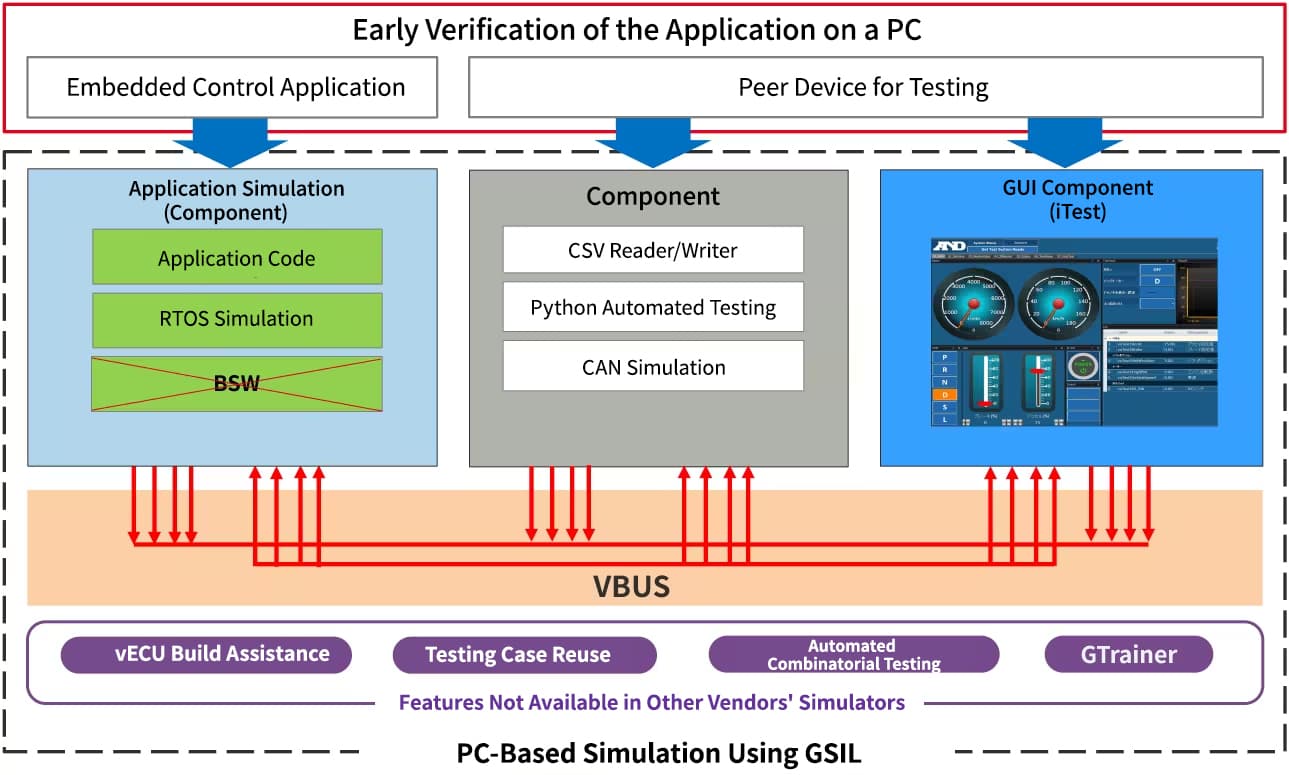
GSIL includes a GUI for input/output: you can vary inputs using sliders in the GUI and check output results in a plotter. Tests can also be run using a CSV file for input. Because GSIL reads and writes input/output directly on VBUS, the BSW layer falls outside the simulation scope, meaning there's no need to handle device drivers that differ from one real ECU to the next.
2. Automated Testing with Python
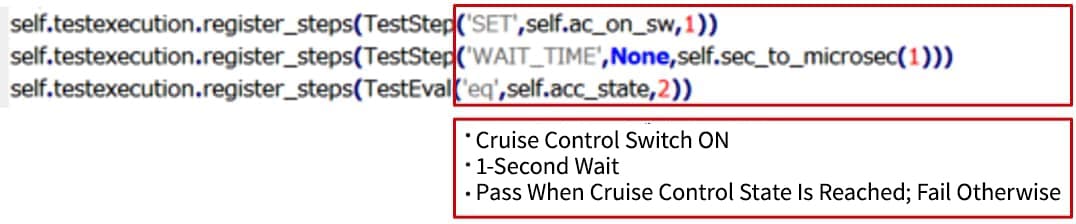
GSIL supports automated testing written in Python. Although Python is used, once you understand the format of the test-instruction arguments, you can write test scripts without needing to know the Python language itself.
3. Automated Exhaustive Testing
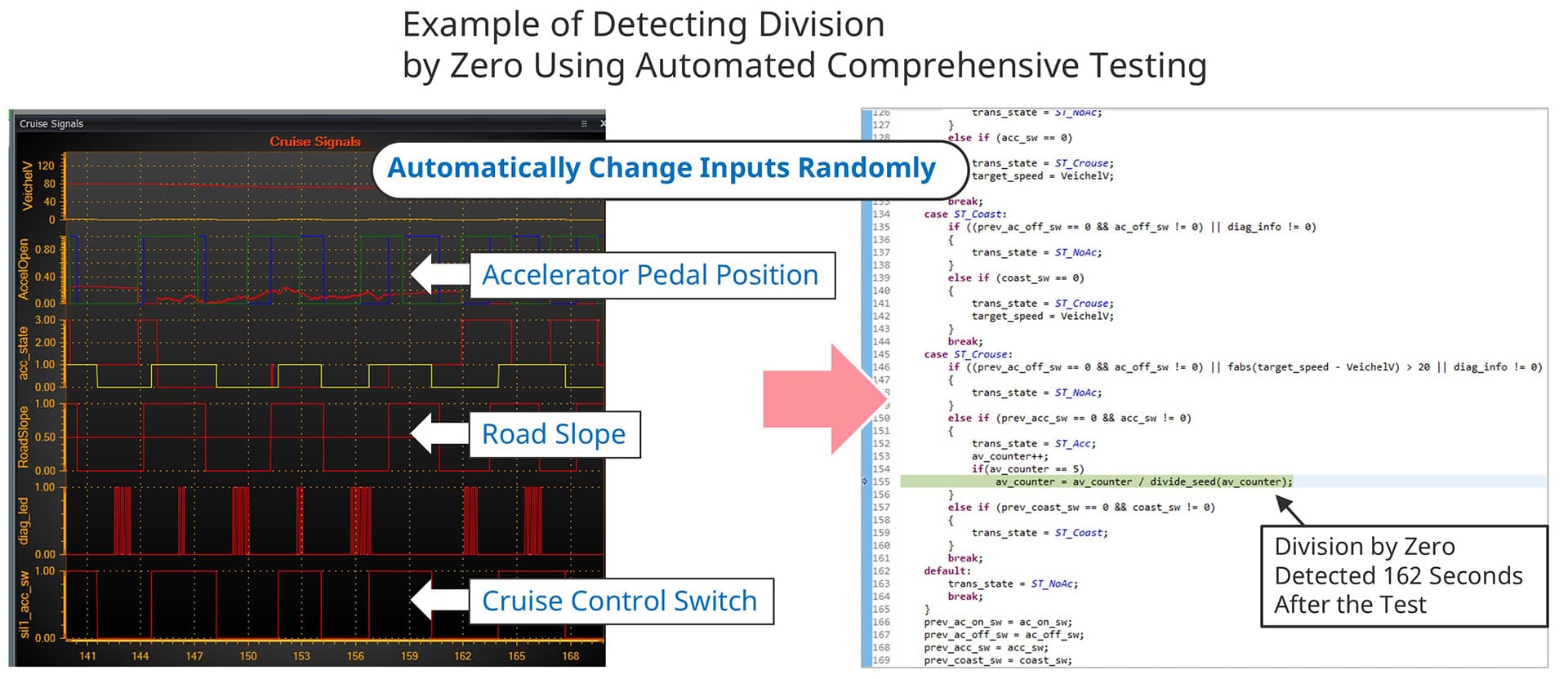
GSIL can automatically generate and run tests covering an enormous number of inputs that would be impossible to test by hand — its automated exhaustive testing. This helps uncover runtime errors, such as division by zero or buffer overruns, that have low reproducibility, are hard to find, and can freeze a device if triggered.
4. Summary
Using GSIL overcomes the challenges of achieving CI in embedded control software development. Software developers simply write and commit code; automated tests run and results can be checked immediately, and if a problem is found, it can be debugged and retested directly in GSIL.
Author

Ubiquitous AI Corporation
Embedded Business Unit 3, Deputy General Manager
Hiroshi Ueda
After university, Ueda joined a Tier 1 supplier and worked on ECU software development. He later worked overseas as an embedded software development engineer before returning to Japan, where he has been engaged in technical sales for automotive software since 1998. Drawing on his own experience, he sources overseas software products that help solve customers' development challenges and delivers them to engineers in Japan.
Related Insights
-
Making the Most of Test Assets in Automotive ECU Simulation
The importance of ECU control software keeps growing, and the test effort that comes with it has become enormous. How can teams make the best use of their test assets? Here we introduce techniques for using those assets effectively, along with the tools that support them.
-
Strengthening Competitiveness in Automotive Control ECU Software Development with SILS
In recent years, more automotive control-software teams have adopted Software-in-the-Loop Simulation (SILS) to make development more efficient. SILS allows code to be verified easily on a PC before hardware is complete, enabling more efficient software development and verification, along with reduced effort.
-
Reducing Rework Between OEMs and Suppliers by Sharing an ECU Control Software Environment
In ECU control software development, defects found later in the V-model require more rework. Learn why early defect detection is critical for reducing costs.
-
Applying GSIL to Continuous Integration (CI)
Learn how Continuous Integration (CI) improves development efficiency by automating code integration and testing, detecting defects early, and reducing rework.
-
Applying GSIL to MILS Development
If MILS enables model-based development, automatic code generation, and ECU validation, what additional benefits can a SILS tool like GSIL provide?
-
SILS Testing Using CAN — Vehicle-Wide Simulation and Test Case Reuse
SILS enables ECU software verification on a PC before hardware is available, supporting CI, automated testing, reduced rework, and improved reliability. GSIL adds CAN support for broader application.
-
Improving Development Efficiency in Embedded Control Software Through Simulation
Improve embedded control software development efficiency with GSIL simulation on PC. Reduce rework, enable automated testing and CI/CD, and boost reliability before hardware is ready.
-
Measuring System-Level Test Coverage
Coverage measurement helps track testing progress, but 100% coverage does not guarantee all input combinations have been tested or that defects are absent.
-
Improving ECU Reliability with GSIL's Comprehensive Automated Test Case Generation
Improve ECU reliability with GSIL’s comprehensive automated test case generation. Detect hard-to-find runtime errors like division by zero and buffer overruns through exhaustive simulation testing.
-
Achieving 90%+ ECU Software Coverage — GSIL's Automated Exhaustive Testing
Struggling to improve coverage or find bugs caused by unexpected input combinations? Learn how GSIL's automated exhaustive testing supports Shift-Left development and improves test effectiveness.