SILS Testing Using CAN — Vehicle-Wide Simulation and Test Case Reuse

SILS is a development-support environment primarily for ECU software. Because it lets you verify software on a PC even before real hardware is complete, it supports easy CI, reduces development rework, and improves reliability through automated testing. GSIL, sold by Ubiquitous AI, is a CAN-capable SILS tool — and CAN support significantly widens its range of applications.
1. Application 1: Integration Testing Combining Real Hardware and Simulation
1-1. Integration testing including a real ECU, using CAN — example 1
1-2. Integration testing including a real ECU, using CAN — example 2
2. Application 2: Automated Testing with CANoe
2-1. Rest-bus testing with CANoe
3. Summary
1. Application 1: Integration Testing Combining Real Hardware and Simulation
One common use case is wanting to run an integration test across multiple ECUs, combining real hardware with simulation.
1-1. Integration testing including a real ECU, using CAN — example 1
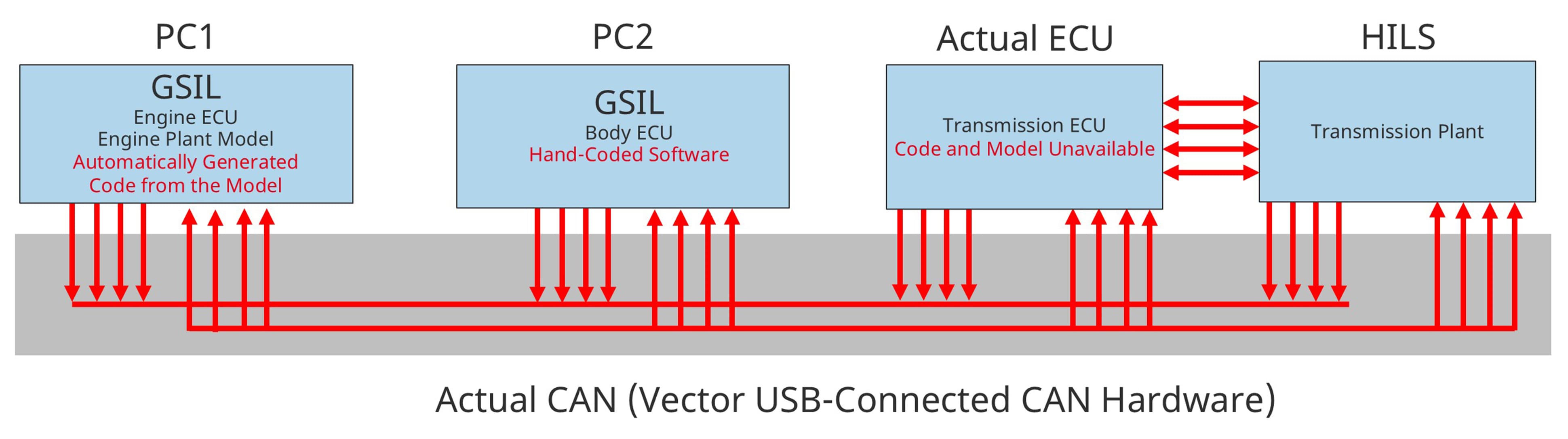
For an OEM wanting to simulate the whole vehicle, in-house source code or models can be tested with MILS or SILS — but obtaining a model or source code for a supplier-provided ECU may not be possible. If it can't be obtained, that ECU must be tested using real hardware. Even so, CAN makes it possible to run an integrated test combining simulation and a real ECU.
The following can be connected over real CAN and simulated together
- hand-written-code ECU
- real ECU
- HILS
(a pattern without HILS is also possible
1-2. Integration testing including a real ECU, using CAN — example 2
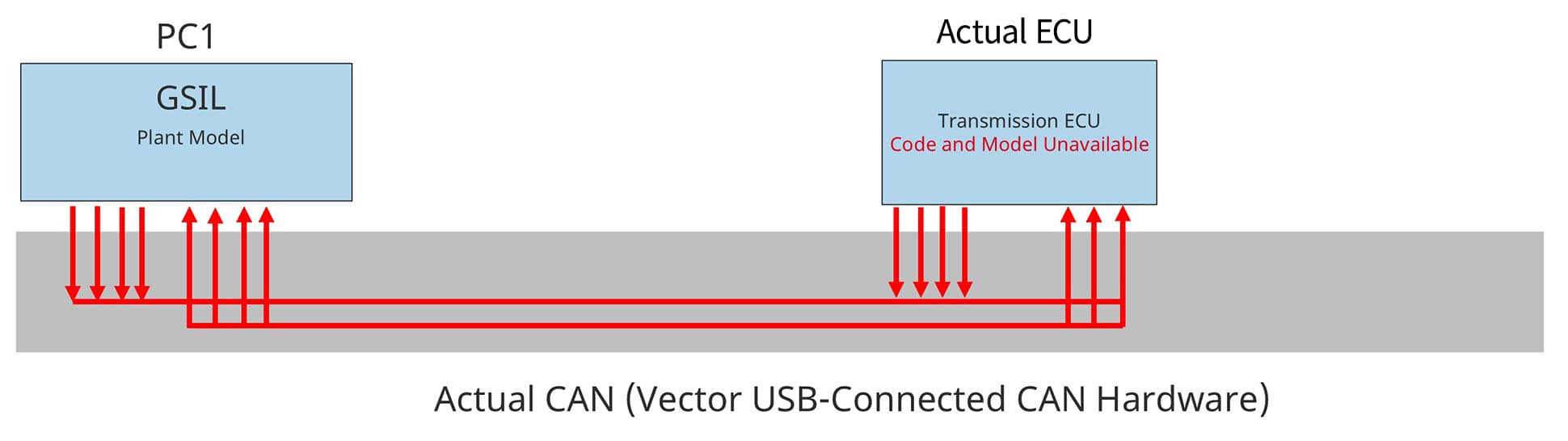
When adding a feature to a real ECU, even without HILS available, a counterpart device with a plant model built in can be constructed easily and inexpensively in place of HILS.
Using GSIL loaded with a plant model as the counterpart device
- useful when adding functionality to a real ECU and HILS is difficult to prepare.
Using Vector's USB-connected CAN hardware with GSIL enables communication over a real CAN bus.
2. Application 2: Automated Testing with CANoe
Automated testing with CANoe is also possible. By running trace data captured from a real ECU, or test cases written in CAPL, teams can reuse test assets and achieve automated testing easily.
2-1. Rest-bus testing with CANoe
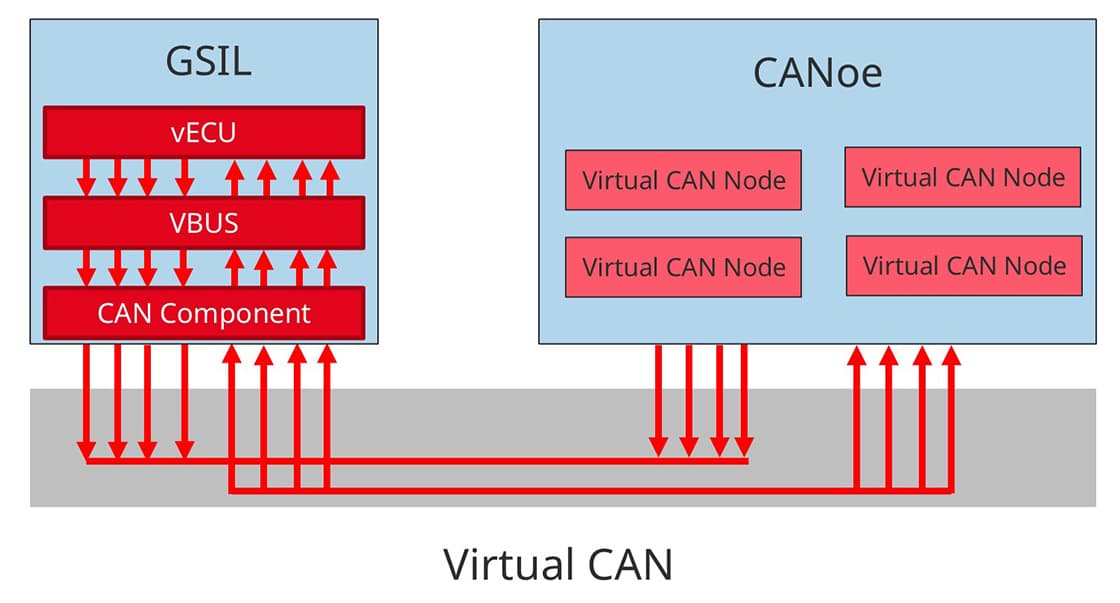
CANoe's virtual CAN node
- run test cases on the virtual CAN node
- real-ECU trace data or CAPL-written test cases
- check GSIL's behavior against those test cases
Even without HILS, a counterpart device with a plant model built in can be constructed easily and inexpensively in place of HILS when adding a feature to a real ECU.
3. Summary
Using CAN significantly broadens the range of SILS applications. If you're interested, please get in touch using the button below — we'd be happy to explain GSIL in more detail.
Author

Ubiquitous AI Corporation
Embedded Business Unit 3, Deputy General Manager
Hiroshi Ueda
After university, Ueda joined a Tier 1 supplier and worked on ECU software development. He later worked overseas as an embedded software development engineer before returning to Japan, where he has been engaged in technical sales for automotive software since 1998. Drawing on his own experience, he sources overseas software products that help solve customers' development challenges and delivers them to engineers in Japan.
Related Insights
-
Making the Most of Test Assets in Automotive ECU Simulation
The importance of ECU control software keeps growing, and the test effort that comes with it has become enormous. How can teams make the best use of their test assets? Here we introduce techniques for using those assets effectively, along with the tools that support them.
-
Strengthening Competitiveness in Automotive Control ECU Software Development with SILS
In recent years, more automotive control-software teams have adopted Software-in-the-Loop Simulation (SILS) to make development more efficient. SILS allows code to be verified easily on a PC before hardware is complete, enabling more efficient software development and verification, along with reduced effort.
-
Reducing Rework Between OEMs and Suppliers by Sharing an ECU Control Software Environment
In ECU control software development, defects found later in the V-model require more rework. Learn why early defect detection is critical for reducing costs.
-
Applying GSIL to Continuous Integration (CI)
Learn how Continuous Integration (CI) improves development efficiency by automating code integration and testing, detecting defects early, and reducing rework.
-
Applying GSIL to MILS Development
If MILS enables model-based development, automatic code generation, and ECU validation, what additional benefits can a SILS tool like GSIL provide?
-
Improving Development Efficiency in Embedded Control Software Through Simulation
Improve embedded control software development efficiency with GSIL simulation on PC. Reduce rework, enable automated testing and CI/CD, and boost reliability before hardware is ready.
-
Measuring System-Level Test Coverage
Coverage measurement helps track testing progress, but 100% coverage does not guarantee all input combinations have been tested or that defects are absent.
-
Challenges and Solutions for CI in Embedded Control Software
Continuous Integration (CI) automates static analysis, unit testing, and integration testing after each code commit, improving quality and development efficiency.
-
Improving ECU Reliability with GSIL's Comprehensive Automated Test Case Generation
Improve ECU reliability with GSIL’s comprehensive automated test case generation. Detect hard-to-find runtime errors like division by zero and buffer overruns through exhaustive simulation testing.
-
Achieving 90%+ ECU Software Coverage — GSIL's Automated Exhaustive Testing
Struggling to improve coverage or find bugs caused by unexpected input combinations? Learn how GSIL's automated exhaustive testing supports Shift-Left development and improves test effectiveness.