Reducing Rework Between OEMs and Suppliers by Sharing an ECU Control Software Environment

ECU control software development follows the V-model. The later a defect is discovered, the more of the preceding process steps must be redone, so the cost of fixing it (rework effort) grows accordingly. That's why finding and fixing defects as early as possible is so important.
1. The Cost of Fixing Defects
ECU control software development uses the V-model. The later a defect is discovered, the more of the process needs to be redone, so the rework effort required grows accordingly.
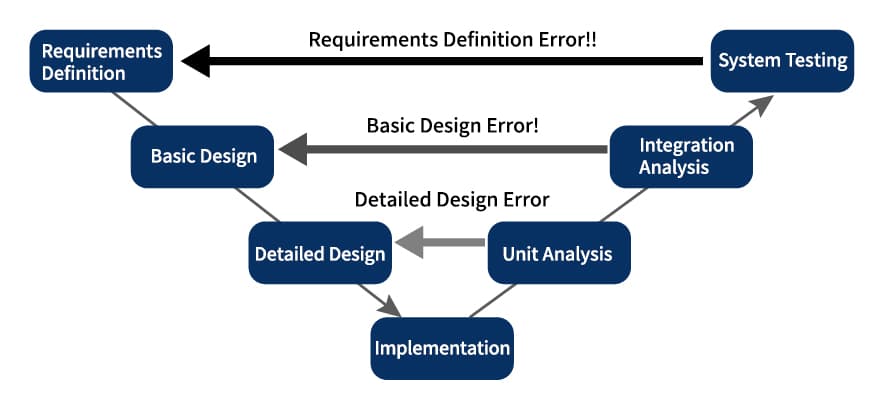
Cost to fix a single defect at each development phase
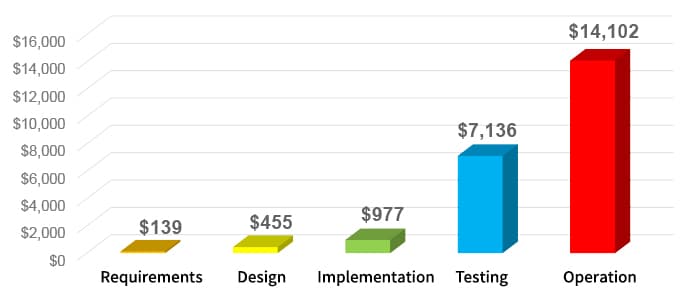
Source: B. Boehm and V. Basili, "Software Defect Reduction Top 10 List," IEEE Computer
- Fixing a defect found during coding: roughly $977
- Fixing a defect found during integration testing: roughly $7,136
- Fixing defects as early as possible is essential
This data, published by Boehm and Basili in IEEE Computer, shows the cost of fixing a single defect at each development phase. Fix costs stay relatively modest before implementation, then rise sharply from testing onward. In automotive ECUs especially, a defect discovered after mass production — potentially triggering a recall — leads to enormous response cost and brand damage, which is why finding and fixing defects as early as possible matters so much. This concept is often called front-loading or Shift-Left.
GSIL, an automotive ECU software development simulation tool co-developed and sold by Ubiquitous AI and A&D Company, is a Software-in-the-Loop Simulation (SILS) tool. Using SILS makes front-loading achievable. SILS itself is covered in our column Strengthening Competitiveness in Automotive Control ECU Software Development with SILS — please have a look.
2. OEM ⇔ Supplier: Where Development Runs Into Problems
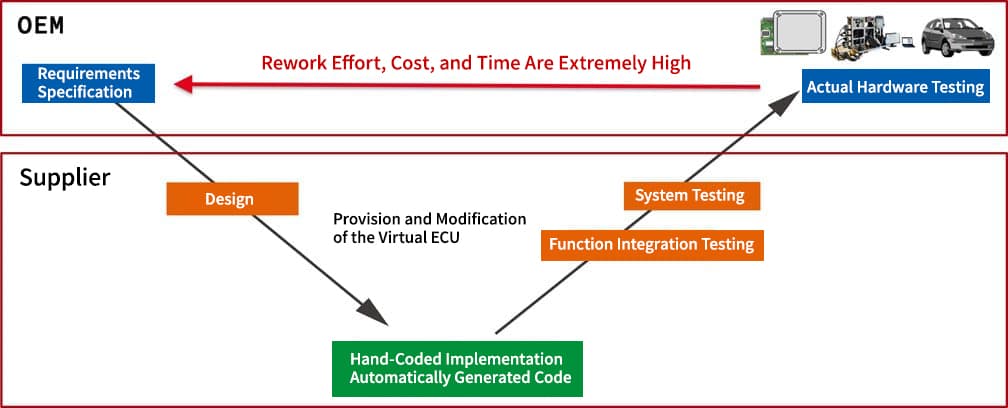
ECU development between an OEM and a supplier typically flows as follows: the OEM creates the requirement specification, the supplier designs, implements, and verifies against it, and delivers the result back to the OEM. If the requirement specification itself contains an error, or the supplier misinterprets it, the mistake typically isn't discovered until after on-target testing is complete and the ECU has already been delivered to the OEM — at which point fixing it requires an enormous amount of effort.
3. OEM ⇔ Supplier: Catching Requirement-Spec Defects Early with SILS
Once SILS lets the supplier check the requirement specification on a PC, that SILS environment can be shared with the OEM. This allows defects in the requirement specification to be found and fixed at a much earlier stage, dramatically cutting rework effort.
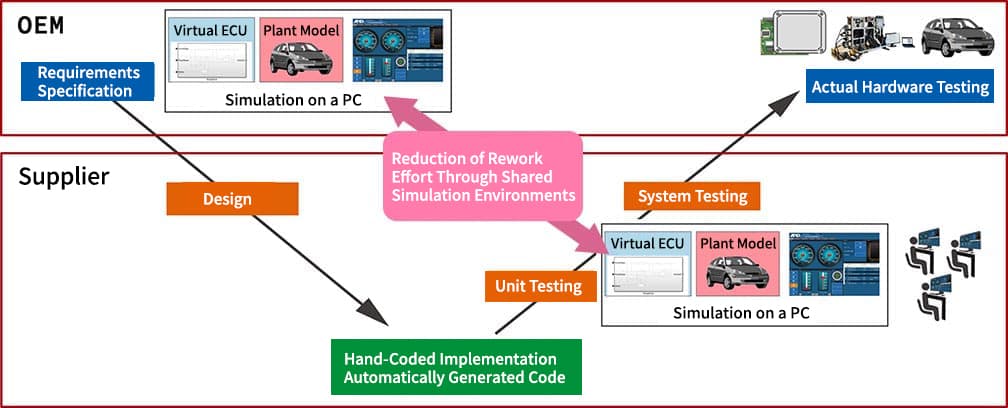
4. OEM ⇔ Supplier: Challenges and Solutions in Early Defect Detection
Sharing a SILS environment between an OEM and a supplier typically runs into three challenges: confidentiality, virtual-ECU setup effort, and tool cost.
4-1. Confidentiality
With GSIL, the virtual environment and plant model are packaged as a DLL, so confidentiality isn't a concern.
4-2. Virtual-ECU Setup Effort
Building a virtual ECU means building and running the application-layer source code with a PC-targeted compiler. Because ECU source code is written using pragma directives and similar constructs targeting the embedded compiler, it can't be used as-is. Compiling only the application layer also produces link errors, since driver-call functions are missing. Traditional SILS requires modifying source code or creating stubs to work around this. GSIL, by contrast, makes environment setup far easier than traditional SILS — compiler support is already built in, and manual changes are largely unnecessary. Link errors are resolved automatically, and stubs are generated automatically.
Actual Hardware Build

Application
Source Code
Middleware
Layer /
Driver Layer

Target
Compiler
Object

Flash
Traditional SILS vECU Build
Application
Source Code
Middleware
Layer /
Driver Layer
(Stub)
Manually Modify the Code in Numerous Places
Windows
Compiler
Virtual ECU
(vECU)

SILS Integration
GSIL vECU Build
Application
Source Code
Middleware
Layer /
Driver Layer
(Stub)
Automatically Modify Microcontroller-Dependent Portions
Automatically Create Stubs
Windows
Compiler
Virtual ECU
(vECU)
SILS Integration
4-3. Tool Cost
Sharing a typical SILS environment between an OEM and a supplier usually requires both sides to purchase the SILS tool. With GSIL, only one side needs to own a license — the other doesn't need to purchase it. This makes it possible to share a development environment between an OEM and a supplier at low cost, while substantially cutting rework effort.
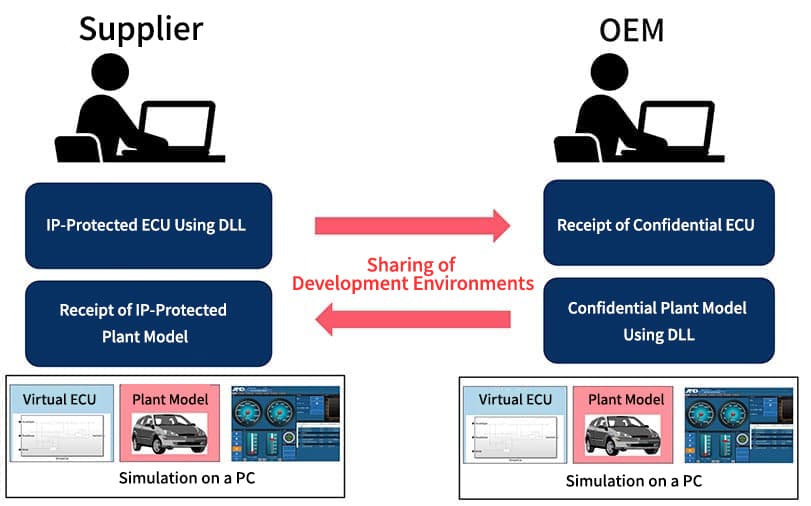
- Semi-automated vECU generation lets suppliers build a virtual ECU easily
- The party providing the ECU or plant model can use GSIL free of charge
- Early verification becomes easy for both OEMs and suppliers
5. Summary
Using GSIL improves the development and verification efficiency of the supplier implementing the software. Sharing that environment between the OEM and the supplier also reduces rework effort caused by requirement-specification defects.
Author

Ubiquitous AI Corporation
Embedded Business Unit 3, Deputy General Manager
Hiroshi Ueda
After university, Ueda joined a Tier 1 supplier and worked on ECU software development. He later worked overseas as an embedded software development engineer before returning to Japan, where he has been engaged in technical sales for automotive software since 1998. Drawing on his own experience, he sources overseas software products that help solve customers' development challenges and delivers them to engineers in Japan.
Related Insights
-
Making the Most of Test Assets in Automotive ECU Simulation
The importance of ECU control software keeps growing, and the test effort that comes with it has become enormous. How can teams make the best use of their test assets? Here we introduce techniques for using those assets effectively, along with the tools that support them.
-
Strengthening Competitiveness in Automotive Control ECU Software Development with SILS
In recent years, more automotive control-software teams have adopted Software-in-the-Loop Simulation (SILS) to make development more efficient. SILS allows code to be verified easily on a PC before hardware is complete, enabling more efficient software development and verification, along with reduced effort.
-
Applying GSIL to Continuous Integration (CI)
Learn how Continuous Integration (CI) improves development efficiency by automating code integration and testing, detecting defects early, and reducing rework.
-
Applying GSIL to MILS Development
If MILS enables model-based development, automatic code generation, and ECU validation, what additional benefits can a SILS tool like GSIL provide?
-
SILS Testing Using CAN — Vehicle-Wide Simulation and Test Case Reuse
SILS enables ECU software verification on a PC before hardware is available, supporting CI, automated testing, reduced rework, and improved reliability. GSIL adds CAN support for broader application.
-
Improving Development Efficiency in Embedded Control Software Through Simulation
Improve embedded control software development efficiency with GSIL simulation on PC. Reduce rework, enable automated testing and CI/CD, and boost reliability before hardware is ready.
-
Measuring System-Level Test Coverage
Coverage measurement helps track testing progress, but 100% coverage does not guarantee all input combinations have been tested or that defects are absent.
-
Challenges and Solutions for CI in Embedded Control Software
Continuous Integration (CI) automates static analysis, unit testing, and integration testing after each code commit, improving quality and development efficiency.
-
Improving ECU Reliability with GSIL's Comprehensive Automated Test Case Generation
Improve ECU reliability with GSIL’s comprehensive automated test case generation. Detect hard-to-find runtime errors like division by zero and buffer overruns through exhaustive simulation testing.
-
Achieving 90%+ ECU Software Coverage — GSIL's Automated Exhaustive Testing
Struggling to improve coverage or find bugs caused by unexpected input combinations? Learn how GSIL's automated exhaustive testing supports Shift-Left development and improves test effectiveness.